Fraud
Fraud, in Dante's moral architecture, is the sin that most offends God because it is the peculiar vice of human beings, an abuse of the intellect and of the bond of trust that holds society together. Virgil explains this hierarchy in Canto XI of the Inferno: "But because fraud is man's peculiar vice, / More it displeases God; and so stand lowest / The fraudulent, and greater dole assails them" (E01594–E01596). This principle governs the entire structure of lower Hell, where the fraudulent are confined in the eight circles of Malebolge and the frozen lake of Cocytus, far below the violent and the incontinent.
The Nature and Gravity of Fraud
Virgil's discourse in Canto XI establishes the theological foundation for the punishment of fraud. He distinguishes two modes: fraud practised on those who trust, which severs the natural bond of love, and fraud practised on those who do not trust, which severs the added bond of special faith (E01621–E01635). The first, more heinous kind is punished in the lowest circle, where traitors are consumed in eternal ice. The second occupies the eight bolge of Malebolge. Fraud is thus presented as a deliberate perversion of the intellect, turning the God-given capacity for reason and language toward deception rather than truth.
The Embodiment of Fraud: Geryon
The monster Geryon serves as the living symbol of fraud and the means of descent into Malebolge. His appearance is a study in deceptive beauty: "The face was as the face of a just man, / Its semblance outwardly was so benign, / And of a serpent all the trunk beside" (E02392–E02394). He has two paws hairy to the armpits, and his back, breast, and sides are "Depicted o'er with nooses and with shields" (E02396–E02397). His tail, quivering in the void, ends in a scorpion's envenomed fork (E02407–E02409). Virgil calls him "the monster with the pointed tail, / Who cleaves the hills, and breaketh walls and weapons, / Behold him who infecteth all the world" (E02383–E02385). Geryon's dual nature—a just man's face on a serpent's body—perfectly mirrors the essence of fraud: an outward show of goodness concealing a poisonous intent. Dante and Virgil ride Geryon down into the abyss, a flight that terrifies Dante more than the falls of Phaeton or Icarus (E02488–E02493).
The Punishments of the Fraudulent in Malebolge
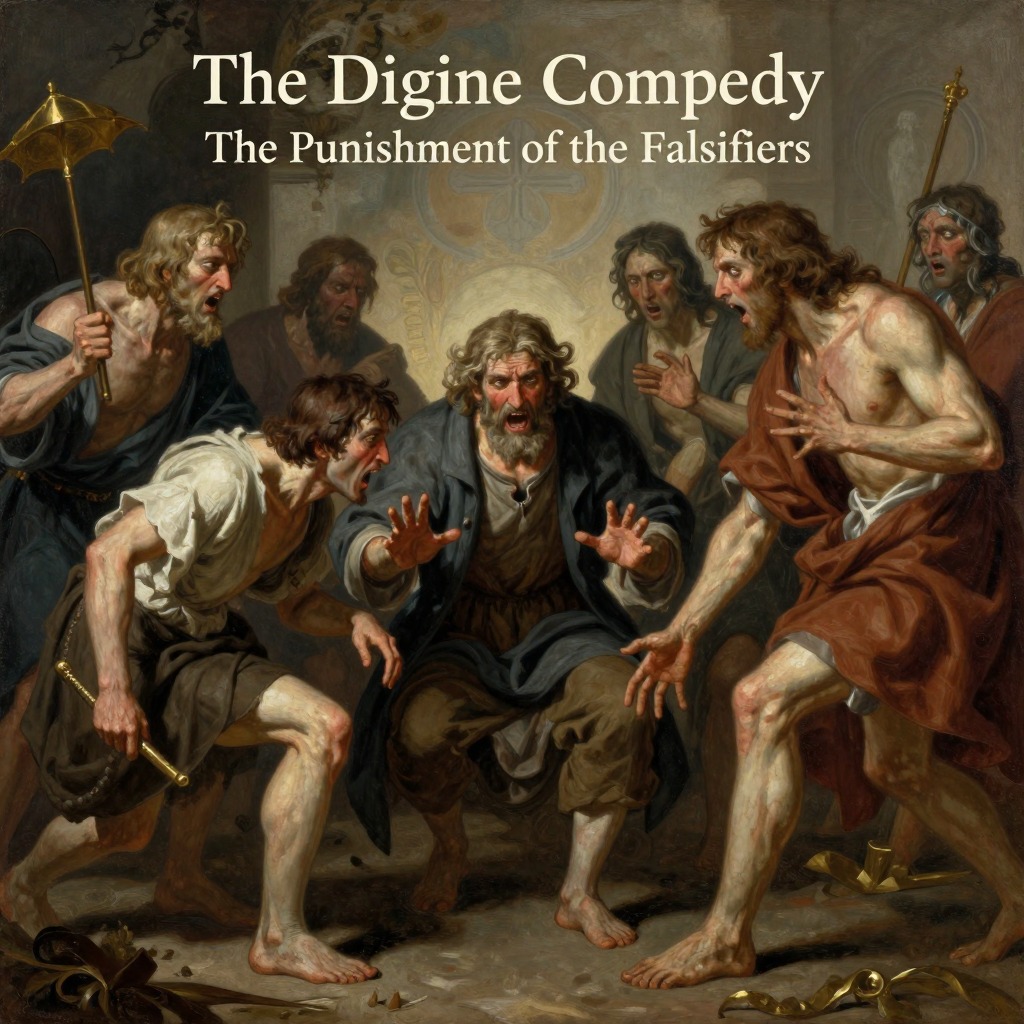
Malebolge, the eighth circle, is a vast stone amphitheatre divided into ten concentric ditches or bolge, each punishing a specific form of fraud. The first bolge holds seducers and panders, driven by horned demons wielding scourges (E02554–E02558). Among them is Venedico Caccianimico, who admits to inducing the fair Ghisola to grant the wishes of the Marquis (E02574–E02576). The second bolge holds flatterers, submerged in human filth; Alessio Interminei of Lucca, his head foul with ordure, confesses that flatteries have submerged him (E02641–E02645). The third bolge punishes simoniacs, thrust head-down into holes in the rock with flames burning their feet; Pope Nicholas III, mistaking Dante for Pope Boniface VIII, laments his simony and prophesies the coming of an even worse pastor (E02708–E02743). The fourth bolge holds soothsayers, their heads twisted backwards on their bodies so that they must walk backwards, weeping into the fissure of their buttocks—a contrapasso for those who claimed to see the future (E02801–E02814). The fifth bolge contains barrators, plunged into boiling pitch; demons called the Malebranche torment them with hooks, and one sinner, Ciampolo of Navarre, tricks the demons and escapes (E03182–E03184). The sixth bolge holds hypocrites, who walk slowly under gilded leaden cloaks; Caiaphas, who counselled the Pharisees to crucify Christ, lies crucified on the ground, weighed down by the very hypocrisy he embodied (E03324–E03336). The seventh bolge punishes thieves, who are tormented by serpents; Vanni Fucci, a bestial thief from Pistoia, is bitten by a serpent, turns to ashes, and then reconstitutes himself, only to be attacked again (E03459–E03467). The eighth bolge holds evil counsellors, hidden within moving flames; Ulysses and Diomed burn together in a double-tongued flame, and Ulysses recounts his final, forbidden voyage beyond the Pillars of Hercules (E03756–E03808). The ninth bolge punishes schismatics, their bodies horribly mutilated by a demon with a sword; Mahomet, his chest ripped open, explains that all here were disseminators of scandal and schism while living (E03977–E03982). The tenth bolge holds falsifiers, afflicted with loathsome diseases; Master Adam, a counterfeiter, suffers from dropsy and an insatiable thirst, while Sinon of Troy burns with fever, and the two quarrel bitterly (E04290–E04358).
The Lowest Depth: Treachery in Cocytus
Beyond Malebolge lies the ninth circle, Cocytus, a frozen lake where the ultimate fraud—treachery—is punished. This is the fraud that severs the special bond of trust, and it is divided into four rounds: Caina for traitors to kindred, Antenora for traitors to country, Ptolomaea for traitors to friends, and Judecca for traitors to lords and benefactors. The sinners are frozen in the ice, their heads bowed or reversed, their tears congealing. Count Ugolino gnaws eternally on the head of Archbishop Ruggieri, who imprisoned him and his sons in the Tower of Famine (E04665–E04742). Friar Alberigo explains that in Ptolomaea, the soul descends to Hell as soon as the betrayal is committed, while a demon takes possession of the living body (E04788–E04796). At the centre of Cocytus, Lucifer himself, the supreme traitor, is fixed in the ice, his three mouths chewing Judas Iscariot, Brutus, and Cassius (E04877–E04889).
Thematic Significance
Fraud, in Dante's scheme, is the sin that most directly opposes the order of love and reason that governs the universe. It is the corruption of the intellect, the faculty that distinguishes humans from beasts, and it destroys the trust that makes civil and spiritual life possible. The elaborate structure of Malebolge and the frozen horror of Cocytus reflect the gravity of this sin: the fraudulent are not merely punished, but their punishments embody the very nature of their deceit. Geryon, with his just man's face and serpent's body, is the perfect emblem of a sin that wears the mask of virtue while poisoning the soul. Dante's journey through these circles is a descent into the heart of human malice, where the abuse of reason becomes a frozen, eternal prison.